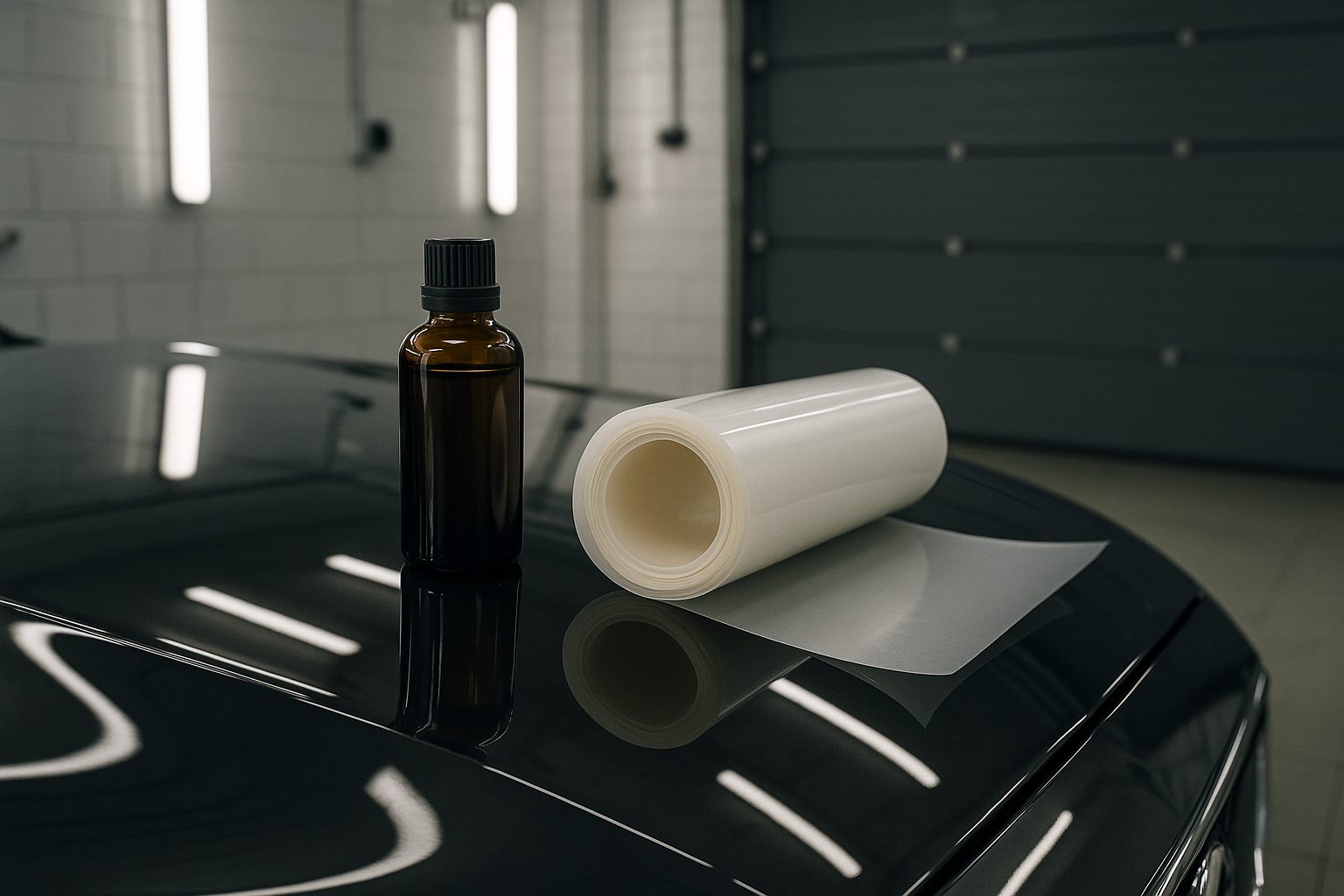
If you've started researching ways to protect your vehicle's paint, you've likely encountered two options: ceramic coatings and paint protection film (PPF). Both offer significant benefits over bare paint, but they're different products designed for different purposes — and in some cases, the best choice is both. Here's an honest breakdown to help you decide.
What Is Ceramic Coating?
Ceramic coating is a liquid polymer applied to your vehicle's paint surface that chemically bonds to the clear coat, creating a semi-permanent protective layer. The coating is based on silicon dioxide (SiO₂), the same material as glass, which is why it's sometimes marketed as "glass coating."
Once cured, a ceramic coating creates a hard, hydrophobic (water-repelling) surface that:
- Repels water, mud, and road grime
- Provides UV protection to prevent paint oxidation and fading
- Resists light chemical contamination (bird droppings, tree sap, industrial fallout)
- Makes washing easier — dirt rinses off more completely
- Adds a significant depth of gloss to the paint
A professionally applied ceramic coating typically lasts 3–7 years, depending on the product and maintenance.
What Is Paint Protection Film?
Paint protection film is a thick, transparent thermoplastic urethane (TPU) film that's physically applied to your vehicle's painted surfaces. It acts as a physical barrier against impact damage. Quality PPF products have self-healing properties — minor scratches and swirl marks in the film disappear when exposed to heat (sunlight or hot water).
PPF excels at protecting against:
- Rock chips and road debris impact
- Scratches from brushes, keys, or light abrasion
- Bug splatter and bird dropping etching
- Minor abrasions from car washes
PPF is typically applied to high-impact areas: the front hood, bumper, fenders, mirrors, and door edges — though full-vehicle wraps are available for maximum protection.
The Key Difference: Hard vs. Physical Barrier
This is the most important distinction to understand. Ceramic coating hardens your paint's surface but doesn't absorb physical impact. A rock chip will still chip ceramic-coated paint. PPF absorbs physical impact — rocks, debris, and scratches hit the film, not your paint.
Conversely, PPF alone doesn't provide the same level of UV protection, hydrophobic properties, or gloss enhancement that ceramic coating does — and it requires a coating over top for maximum longevity and appearance.
The ideal combination: Apply PPF to high-impact zones (front end, mirrors, rockers), then top coat the PPF and the rest of the vehicle with ceramic coating. You get physical impact protection where you need it most, plus the hydrophobic and UV benefits across the whole vehicle.
Cost Comparison
Ceramic coating for a full vehicle runs roughly $800–$2,500+ depending on the product tier and vehicle size. PPF is more expensive — partial coverage (front end protection) typically runs $1,500–$3,000, while full-vehicle PPF can exceed $6,000–$8,000. The combination of both represents the premium tier of paint protection, suited for new vehicles or high-value cars.
Which Is Right for You?
If your priority is ease of washing, UV protection, and enhanced gloss on an existing vehicle, ceramic coating is an excellent choice. If you're buying a new vehicle and want maximum protection against chips and scratches — especially if you drive on gravel roads or highways with significant debris — PPF on the front end is a smart investment. If budget isn't a constraint, combining both provides the most comprehensive protection available.
Our team at CRU-Tech can walk you through both options for your specific vehicle and driving situation. Book a consultation and we'll give you an honest recommendation.
Ready to Book an Appointment?
Our team at CRU-Tech Auto is here to help. Give us a call or send us a message.