If you've lived in Kamloops for more than a few summers, you already know the drill. The sky turns that strange orange-grey, the air smells like a campfire, and air-quality alerts start scrolling across your phone. Wildfire smoke has become a regular feature of BC Interior summers, and it puts more strain on your vehicle — and your lungs — than most drivers realize.
One of the simplest and most overlooked defences against smoky-day driving is something most people forget exists: your cabin air filter.
What a Cabin Air Filter Actually Does
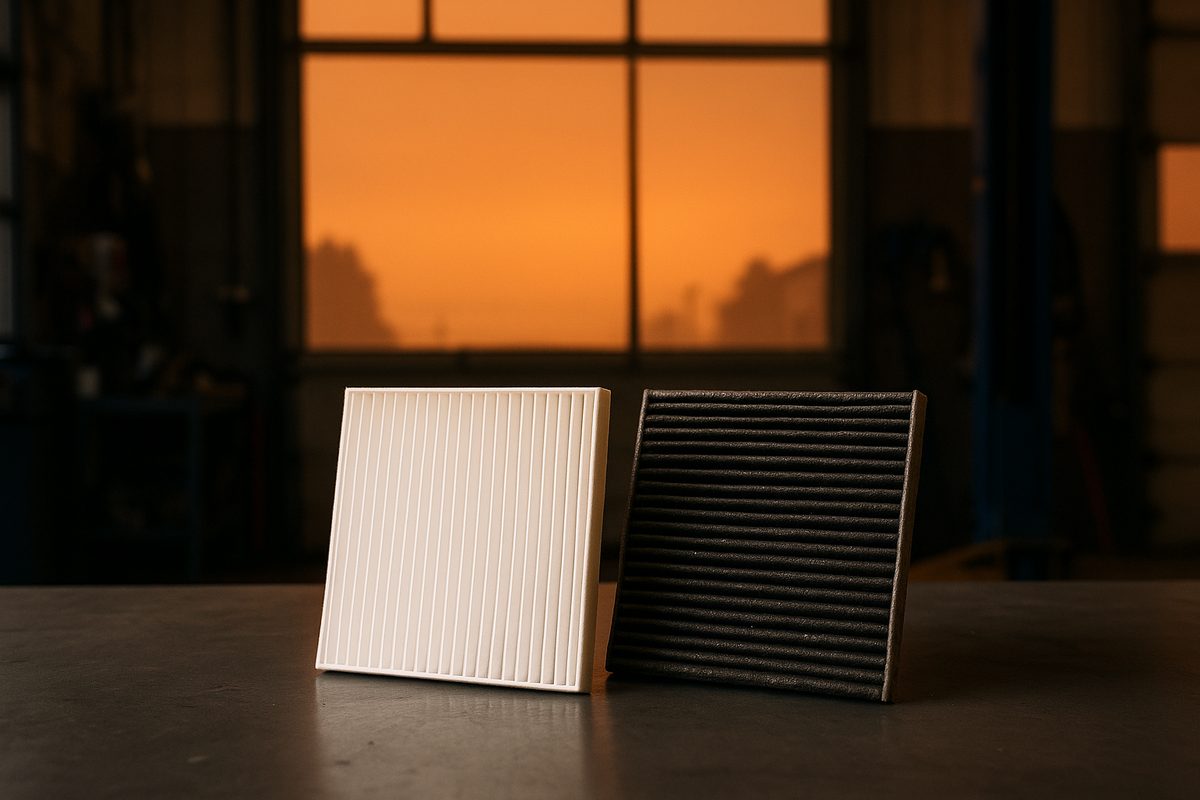
Your cabin air filter is a pleated paper or fibre element tucked behind the glove box (in most vehicles) that cleans the air being pulled into the cabin through your HVAC system. Every time you turn on the heat, AC, or defrost, that air passes through the filter before it reaches you. A good filter traps dust, pollen, road grime, exhaust particulates, and — critically for BC drivers — the fine PM2.5 particles found in wildfire smoke.
It's a different filter from your engine air filter, and it's just as important to swap out on schedule.
Why It Matters More in Kamloops
Three things make this a bigger deal here than in many other Canadian cities:
- Wildfire smoke. BC summers now routinely see weeks of degraded air quality. A clogged or expired filter lets more of those particulates into your cabin.
- Dust and pollen. Kamloops grasslands kick up a lot of fine dust, and spring brings heavy pollen loads through the Thompson Valley.
- Highway driving. The Coquihalla, Highway 1, and Highway 5 all push your HVAC system harder than stop-and-go city driving — and a dirty filter restricts airflow, making your blower motor and AC work harder.
Signs Your Cabin Air Filter Needs Changing
- Weak airflow even with the fan on high
- Musty or dusty smell when you turn on the AC or heat
- Whistling sounds from the vents
- Foggy windows that take longer than usual to clear
- Visible dust or leaf debris when you pull the filter out
Most manufacturers recommend changing the cabin air filter every 20,000–30,000 km, but in dusty or smoky environments — which Kamloops definitely qualifies as — every 15,000 km or once a year is a smarter target.
Upgrading to a HEPA or Activated Carbon Filter
If wildfire smoke is a concern for you (and for anyone with asthma, allergies, or young kids in the back seat, it should be), it's worth asking about a HEPA-style or activated-carbon cabin filter when you replace it. These filters trap finer particles and absorb odours far better than the basic OEM paper filter. The upgrade typically costs only a few dollars more and can make a real difference on smoke-heavy days.
Don't Forget the AC System
A fresh cabin filter also takes load off your AC system, which is doing double duty in Kamloops summers — cooling the cabin and helping pull smoke and humidity out of the air. Pairing a filter swap with an AC performance check before the heat hits is one of the cheapest ways to keep summer driving comfortable.
Book a Cabin Air Filter Service at CRU-Tech
We can swap your cabin air filter while you wait, recommend an upgrade if it makes sense for your driving, and check your AC system at the same time. Drop in or book ahead — your lungs will thank you the next time the smoke rolls in.